
Patron Saints: A Career-Positioning Lesson from Art History
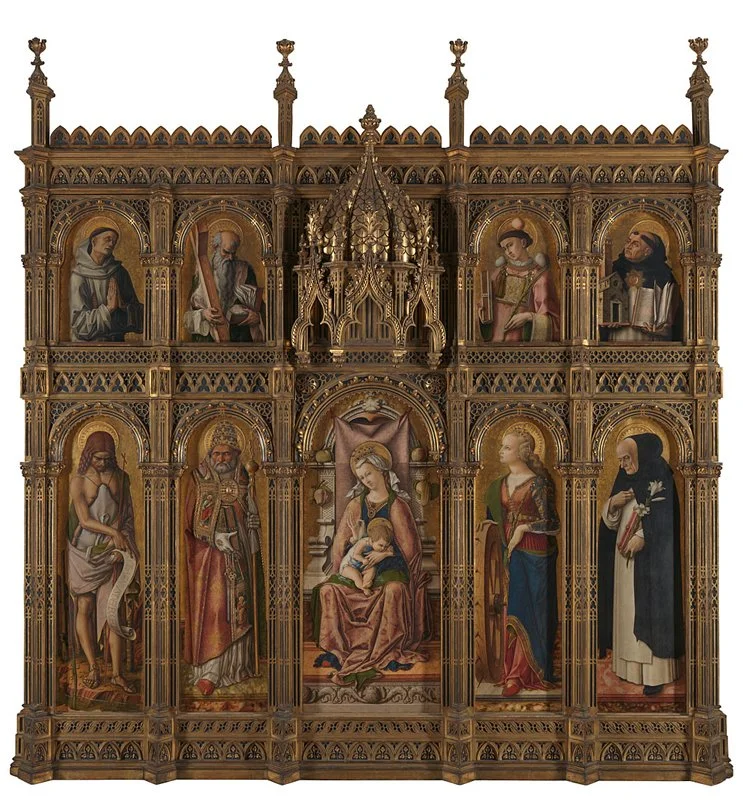
The Demidoff Altarpiece by Carlo Crivelli, now owned by The National Gallery UK
If you didn’t grow up with stories of the Catholic Saints, let’s use art history as an entry point. The National Gallery in London houses a magnificent work known as The Demidoff Altarpiece. Italian Renaissance painter Carlo Crivelli created two altarpieces for a small church in the town on Ascoli Piceno. At some point, the works were broken into parts and sold to a Russian Prince – Anatole Demidoff – who cemented his association with the masterpiece by having capital, and I suppose, taste.
The restored work, acquired by the National Gallery in 1868, features the Virgin and Child in the center, surrounded by Saints. Saint Catherine of Alexandria is here, pictured with her spiked wheel. Saint Jerome gazes at his works, while a lion the size of a Cocker Spaniel sits at his feet. Saint Stephen is pictured with … what are those … potatoes? Seashells? Oh, rocks. Saint Stephen was stoned to death. The wheel, the lion, the… stones: art historians call these attributes, and for most of the pre-literate medieval and early Renaissance world, they weren’t decorative. They were identification technology.
An attribute was the single object — occasionally the single gesture or animal — that told a viewer which saint they were looking at. It was visual shorthand, compressed from an entire hagiography into one recognizable element. Catherine’s wheel: the instrument of her attempted martyrdom. Jerome’s lion: the wild animal he calmed in the desert by pulling a thorn from its paw. Stephen’s stones: the instrument of his execution following accusations of blasphemy.
What interests me is that every attribute was drawn from a single moment, not a résumé of miracles. One scene from one story — usually the scene of greatest consequence — rendered into one object a viewer could recognize across a crowded nave, in bad light, from thirty feet away.
This was “positioning”, centuries before the concept existed.
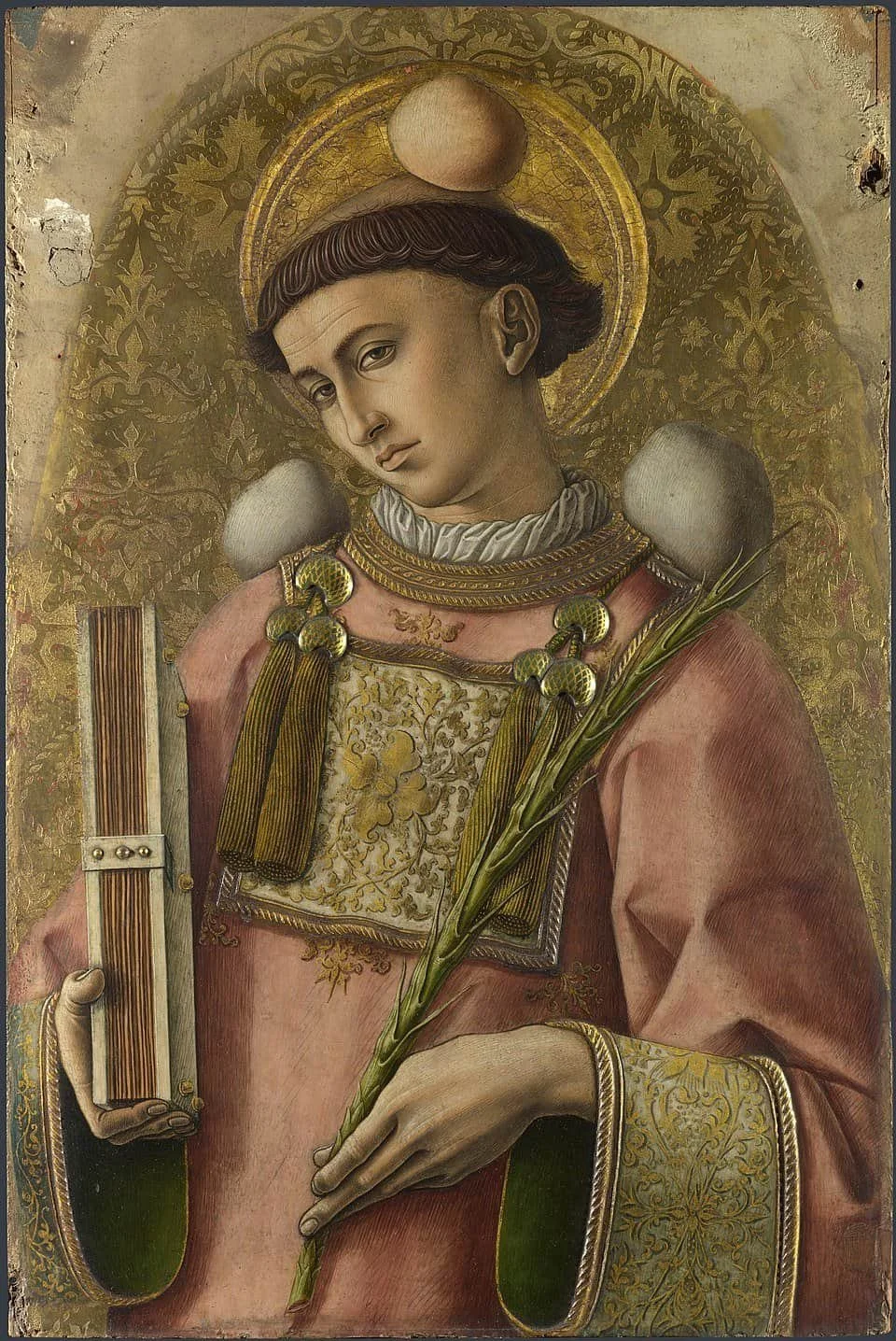
Saint Stephen: is that a potato on your shoulder or are you just happy to see me?
I’ve been thinking about attributes lately, because most of the mid-career professionals I work with have the exact opposite problem. They have CVs. They have LinkedIn headlines that read like a panel of adjectives: Strategic. Transformational. Cross-functional. Results-driven. These are attempts at positioning the way a wall of text is an attempt at a painting. They contain too much and reveal too little.
A CV tells people what you’ve done. An attribute tells people when they need you.
I’ve written before about how a single semantic choice — a brand name, a title — can function as another color on the painter’s palette. An attribute is the same principle at the human scale. One object, carefully chosen, carries the weight of a whole story.
The distinction matters more in a transition than at any other moment in a career. When you’re inside a role, your context positions you — your title, your employer, the hallway you walk down every morning. When you step out of that context, into a job search or a pivot or a founder’s year, the positioning evaporates. The job market sees you only as a list of past employers. You do not want to be a list. Lists are referenced. Attributes are remembered.
The patron-saint test is an exercise I sometimes use in brand discovery sessions: if someone were to paint a portrait of you that had to communicate, at a single glance, the moment you are most necessary — what is the object in your hands? Not a symbol of your industry. Not a tool you happen to use. The specific artifact of the specific scene where your presence changed an outcome.
Don’t worry, almost no one can answer this on the first try. We’re encouraged to optimize our experience as a list on a résumé rather than consider it a hallmark in our self-presentation. But don’t throw out those old lists: when I work with professionals on their talent brand, we mine those lists for the inciting incident.

Saint Therese of Lisieux, often portrayed with roses. Photo by Nick Castelli on Unsplash
In my practice this takes the shape of a three-part framework I call Moment / Impact / Edge.
Moment is the specific circumstance in which you are most needed. Not “leadership.” The eighteen-month turnaround. The post-acquisition comms rebuild. The launch that had to happen with half the team.
Impact is what changed because you were there. Not “increased conversion rates by 15%.” What did your participation make possible?
Edge is the non-obvious element of your approach. The thing your peers don’t do, can’t do, or don’t think to do. The wheel, the lion, the stones.
Together, these three answers constitute the secular equivalent of an attribute. They distill a career into a sentence a stranger can repeat after hearing it once. They give the market something to remember you by that isn’t a keyword.
This is the work I do in the Talent Brand Workshop — a 90-minute 1:1 session for mid-career professionals who have the experience but lack the positioning. It’s the same discipline I apply in Clew’s brand strategy work with expert-led businesses, applied to the topic where everyone is naturally an expert: themselves.
It’s highly unlikely that someday the world’s greatest artists will paint your portrait or sculpt your likeness. But everyone you meet in a transition is, in their own small way, rendering you into a single object they’ll recognize later. Are you leading with the attribute you want to be remembered by, or are you leaving the sketch unfinished?
Nancy Martira is a brand strategist and communications consultant. She delivers human-centered strategies tailored to your specific business challenges and market position. Hire Nancy for brand positioning, messaging, and content strategy projects. Have something else in mind? Let’s talk.
