
Why Taskmaster is the Best Show About Adult Play
This essay first appeared in the August 12, 2026 Wonder Work email newsletter. Subscribe to Wonder Work here and get the next issue directly in your inbox.
The Small Idea: There is nothing pointless about celebrating the many weird, wonderful ways that different brains work.
The Spark: Alex Horne and Greg Davies on Bullseye with Jesse Thorn, July 14, 2026.
What if the real gift of a silly game show is that it hands a dozen different brains the same daft instruction, lets each one take a completely different run at it, and then cheers for all of them?
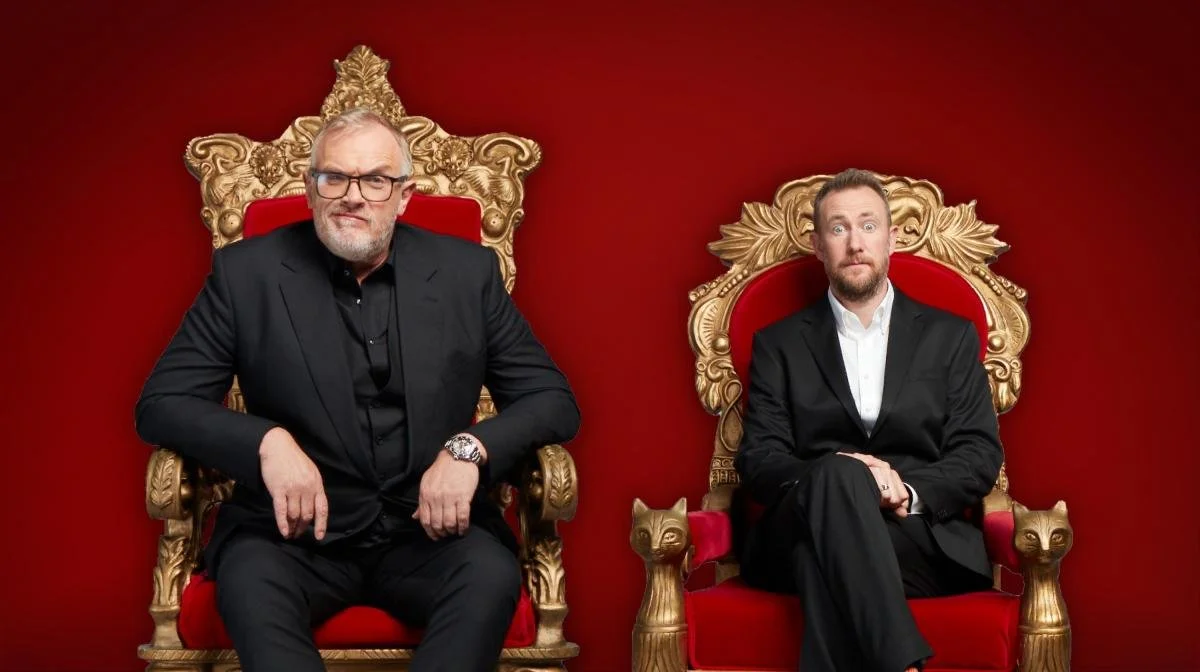
Publicity still from Taskmaster, Avalon Productions, Channel 4
“Imagine a TV show, a game show, where the stakes could not be lower,” Jesse Thorn. “... and imagine a game show where the contestants could not be more invested in the outcome of the game.”
Everyone describes the British TV show Taskmaster a little differently. I’m fond of this explanation from Jesse Thorn because I believe the ridiculously low stakes are integral to the magic of the show. If you’re not familiar with the show, I have great news for you. All 20+ seasons and counting of the program are available in full to watch for free on YouTube. Don’t start at the beginning; I started with Season 21 and worked backwards. This is my unqualified recommendation.
Each season, five comedians submit to ridiculously sublime tasks developed by Alex Horne, in hopes of impressing Taskmaster Greg Davies, who capriciously hands out arbitrary points. That’s it. That’s the show. There is no cash prize, brand deal, or Vegas residency awaiting the champion. Winning is nearly beside the point. Here’s the tell:
In 2026, Greg and Alex toured a stage-show version of Taskmaster across the United States. There was, of course, an accompanying media blitz to raise the profile of the show in the US. After an NPR producer stumbled valiantly through a warm-up task on an episode of Weekend Edition, Horne didn't congratulate her or correct her. He just said, warmly, "It was lovely watching you think."
Hand five comedians a balloon, a piece of string, and a countdown, and you get five entirely different theories of the universe. One person over-engineers. One person panics. One person finds a loophole nobody knew was there. The show is a machine for making a person's private way of thinking suddenly visible — and it never, ever pretends there was only one right answer. When was the last time anyone said that to you — not well done, not here's how you should have done it, just: it was lovely watching your particular brain do its own thing?
“It was lovely watching you think.”
A Variety of Solutions
Ask Horne what makes a good task and he gets specific: "something which has a variety of solutions, something that's inherently slightly funny but not too funny." That first half — a variety of solutions — is the entire design philosophy, and it's why the show works on brains the way it does. A good task can't have one right answer; that’s a test. A great task has to have twelve possible answers, most of them wrong in interesting ways. It rewards the brain that comes at a problem sideways, the brain that reads the instructions too literally, the brain that ignores the instruction entirely and does something stranger and better.
That's a quietly radical thing to build. Most of the structures we move through — school, work, social algorithms — are sorting mechanisms that reward one approved route and gently punish the rest. There are no ringers, no favorites going into the competition. It’s impossible for any one person to be good at every task: by devising tasks around problem-solving, artistic expression, pattern recognition, music, improvisation, agility, bluffing, sincerity, memorization, guestimating, and throwing darts (just to name a few) absolutely everyone will encounter a task that undoes them. This usually happens once an episode and it’s the second best part of the show.
“The Most Autism-Friendly Job on Television”
The person who has said this best is not the creator of the show or a critic, it's a contestant. Fern Brady, the Scottish comedian who competed in Series 14 and is diagnosed autistic, wrote in her 2023 memoir Strong Female Character that Taskmaster was ‘unintentionally the most autism-friendly job I'd ever had, because it's a show that values being yourself.’ She describes choosing to blurt her first instinct instead of hunting for the "correct" thing to say — and being met with cheers instead of derision. She felt, she wrote, "a very pure happiness that I didn't feel in the hellish forced group banter of panel shows." What she's describing is a format that accidentally removed the tax most social situations charge an autistic person: the constant, exhausting work of reading between the lines and performing the expected reaction. On Taskmaster you come into a quiet house, alone, and you're handed a clear written instruction and a stopwatch. Do the task, have a cup of tea, do the next one. The structure that a neurotypical viewer reads as "quirky" is, for a brain like Brady's, a kind of oxygen. She's said the show let her unmask — let her autistic traits be visible — in a way panel shows never did. The wonderful accident is that the exact conditions that let her stop performing are the conditions that make her, on screen, magnetic to watch.
“It’s incredible how different brains perform under pressure.”
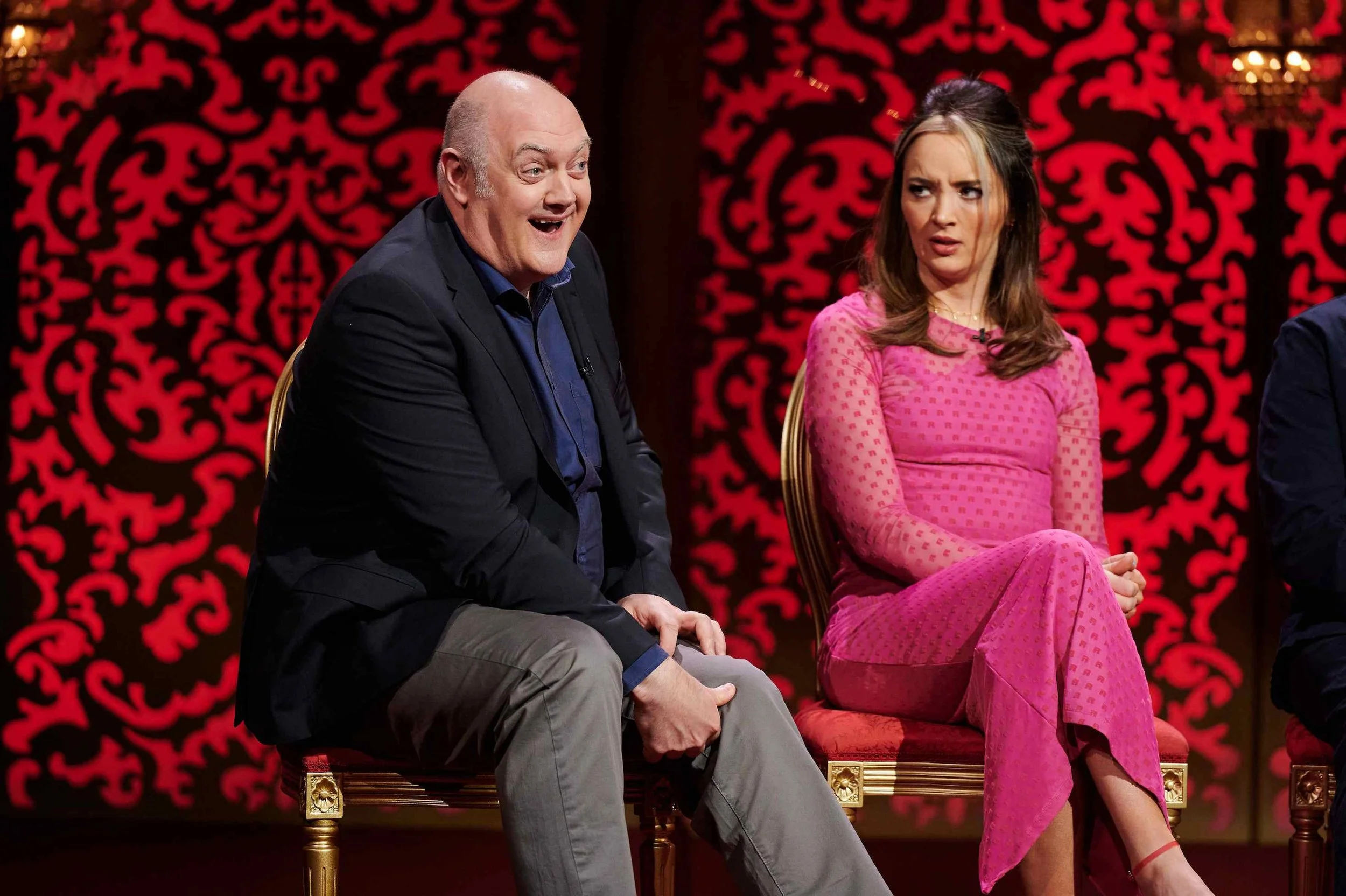
Dara ó Briain and Fern Brady on Series 14 of Taskmaster
Nobody Gets Humiliated
Here is the rule that makes this good-natured fun possible. "It may look on the surface like we're trying to humiliate people," Davies has said, "but we're not. We're just — I think we're sort of celebrating the ridiculousness of all of us." Horne puts the mechanics plainly: the tasks are "pretty neutral," a "safe space," and it's up to the contestants to embarrass themselves if they want to. The tasks are engineered never to demean the person doing them; any silliness is self-chosen and therefore affectionate. Early on, the team cut a task that sent contestants to high-five a stranger in a shopping centre, because it created the wrong kind of discomfort — the kind aimed at someone who hadn't signed up for it. That principle gets tested most when the show casts a brain or a body the wider culture hasn't made room for. When Rosie Jones — a comedian with cerebral palsy — joined Series 18, she was met with a wave of ableist abuse online just for being there. Mild-mannered Horne called it "really disgusting" and dropped his persona to show the public how truly angry he was. Throughout and after the broadcast, Horne and the production supported her presence on the show, ensuring her dynamic on set remained collaborative and treated with standard Taskmaster parity.
And the British Comedy Guide has noted that the format keeps drawing neurodivergent performers — Rhod Gilbert and Aisling Bea (ADHD), Katy Wix (autism), Fern Brady — precisely because it applauds an out-of-the-box attempt even when it scores zero points. In a moment when the most powerful leaders in our government mock and vilify anyone who is different, a wildly popular low-stakes British game show reminds us that it doesn’t need to be this way.
“In a moment where the most powerful leaders in our government mock and vilify anyone who is different, a wildly popular low-stakes British games show reminds us that it doesn’t need to be this way. ”

One of my favorite Taskmaster contestants: Fatiha El-Ghorri from Series 19
Two Small Experiments to Try
Experiment 1: Your Time Starts Now.
Write yourself a Taskmaster-style task this week, complete with a silly constraint and a real timer. Something like: Make the most beautiful thing you can out of what's currently in your junk drawer. Most beautiful wins. You have twenty minutes. Your time starts now. Pay attention not to the result but to your own method — the order your brain reaches for things, the rule you instinctively bend. You are watching your own particular mind work, probably for the first time in a while.
Then, send me your tasks!! I want to know what you came up with and how you did.
Watch Somone Think
Borrow Horne's line. Hand a kid, a friend, or a partner a puzzle — a riddle, a physical challenge, a question from Lateral — and then do the genuinely hard part: don't help. Don't hint. Don't steer them toward the route you'd take. Just watch them think, and notice how completely unlike your own their path is. The point isn't the answer. It's the lovely, specific strangeness of a brain that isn't yours.
The Wonder of Different Brains
The tasks at the heart of Taskmaster may be pointless at best, but they reveal a deadly serious truth: there is never just one right way to do a thing. The sealed envelope, the wax stamp, the arbitrary points Greg awards for reasons he does not need to explain — the entire structure isn't there to elevate the most neurotypically accomplished person; it's there to make the world just a little bit safer for those who don’t conform to the status quo.
Give twelve people the same daft instruction and you don't get twelve attempts at one answer; you get forty entirely different interiors, briefly turned inside out for you to marvel at. Somewhere along the way most of us learned to treat a brain that works differently — too literal, too sideways, too fast, too slow, wired to a body that moves its own way — as something to be smoothed down and corrected into the standard shape. Taskmaster is a weekly, wax-sealed argument that we’ve got it all backwards. Joy doesn’t come from arriving at a “correct” solution; the delight is in the many different and unexpected ways we find to get there. It takes a truly silly show to reveal the profound beauty of diverse minds.
The Question
How does it feel when you watch a mind work in a way completely unlike your own?
Nancy Martira is a brand strategist and communications consultant. She delivers human-centered strategies tailored to your specific business challenges and market position. You can hire Nancy for brand positioning and content strategy projects. Have something else in mind? Let’s talk.
