
What Your Return to Office Mandate Says About Your Brand
A policy is never just a policy. It's a proof point about who you are — and a lot of leaders are saying more than they mean to.
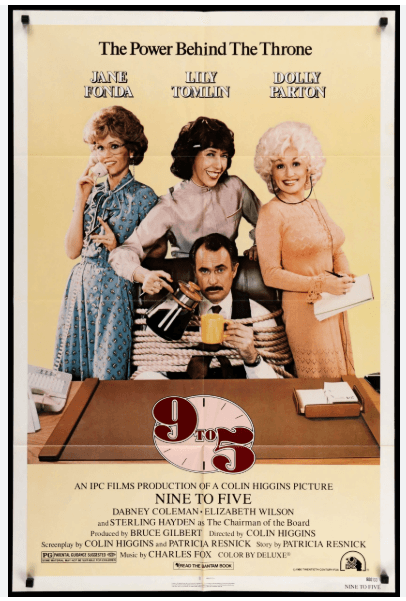
In 1980, the highest-grossing comedy in America was a revenge fantasy about three women and a blowhard boss. 9 to 5 gave us Dolly Parton, Jane Fonda, and Lily Tomlin as office workers who, through a sequence of escalating misunderstandings, end up holding their boss hostage in his own home. Franklin Hart Jr. — "a sexist, egotistical, lying, hypocritical bigot," per Violet's immortal description — is the kind of man who steals his employees' ideas, gropes his secretary, and rules by intimidation from behind a big desk.
While Hart is tied up in his bedroom, the women quietly run the department their way. They install flexible hours so parents can manage school pickups. They set up a job-share. They open an on-site daycare. They paint the place, hang art, let people work how they actually work. And productivity climbs twenty percent. When the chairman of the board shows up to congratulate Hart on the turnaround, Hart takes the credit — for every reform he would never have allowed.
That movie is forty-six years old. I bring it up because last week The New York Times published two articles, one day apart, that together describe the exact same office — and the exact same boss.
“The film understood something in 1980 that some leaders still haven’t: the man at the big desk and the humane, flexible workplace are not on the same side.”
A Tale of Two Headlines
Let’s look at the stories behind two headlines from last week. The first, a guest essay by the Wharton organizational psychologist Adam Grant and his colleagues Marissa Shandell and Courtney Elliott, is titled "The Secret Reason Bosses Want Everyone Back in the Office, Every Day of the Week." Their six years of research lands on an uncomfortable finding. The trait that most reliably predicts a leader's hostility to remote work isn't a concern for productivity, collaboration, or culture. It's narcissism. Across executives and frontline supervisors, the people who most wanted everyone back five days a week were the ones who scored highest on self-importance, entitlement, and the craving for status. The researchers even found the pattern in Fortune 500 CEOs, using the size of their pay packages, their signatures, and their photos in annual reports as proxies for ego.
Remote work, Grant argues, starves a certain kind of leader of a certain kind of supply: the live audience. You can't intimidate over Slack. You can't pound a conference table on Zoom. You can't be worshipped at the office altar if no one is in the temple.
The second article, by Claire Cain Miller, ran the day before and is titled "How Remote Work Has Helped a Generation of Working Parents." It is, in almost every way, the inverse story. Drawing on Brookings analysis and her own interviews, Miller documents how flexibility kept a generation of mothers in the labor force — especially mothers of children under five, the group economists watch as a bellwether because they're the most likely to be pushed out. Some of the women she interviewed said flatly that they would not have had children, or would not have kept their careers, without the ability to work from home. The share of mothers of young kids in the workforce has stayed above its 2019 level. That is not a small thing. That is a structural shift.
One headline is about ego. The other is about working moms. It’s the same story told from two different perspectives.
The Ideal Worker Has Always Been a Man with a Wife At Home
For most of the twentieth century, American work was built around what sociologists call the ideal worker — someone fully available to the employer, unburdened by the daily logistics of feeding, raising, or caring for anyone. That worker could stay late on no notice, travel on demand, and treat physical presence as proof of commitment. The ideal worker was never a neutral figure. He was a man with a wife at home doing the invisible second shift that made his availability possible. The economist Claudia Goldin, who won the Nobel for studying women in the workforce, calls it "greedy work" — jobs that pay a steep premium for being always on, and quietly penalize anyone who can't be.
Face time is the ritual of greedy work. And greedy work has a gender, even when no one says so out loud.
This is what makes Grant's findings a bit of a no-brainer (although I’m glad he’s saying it out loud.) The behaviors he describes — hovering at desks, slamming doors, pounding tables, staring people down, basking in reverence from the corner office — aren't just narcissism in the abstract. They're a specific, gendered performance of authority. Think of Dabney Coleman’s performance as Franklin Hart: power is something you display in a room rather than something that is a natural byproduct of business results. A return-to-office mandate, in this light, isn't only an ego refill. It's a reinstatement of the ideal-worker norm. It quietly re-sorts the workforce back into people who can perform constant presence and people who can't — and we have decades of data on who tends to fall into which group.
Miller's reporting brings the receipts. When you give people flexibility in the office, mothers stay, fathers do more at home, and people caring for aging parents stop hiding it. When you take flexibility away, the research she cites shows the same mandates that bruise everyone hit caregivers hardest — and disproportionately, women. So when a leader announces five days a week "for the culture," the feminist reading and the strategic reading converge on the same conclusion: executive ego-feeding is more important than getting the best work out of the best people.
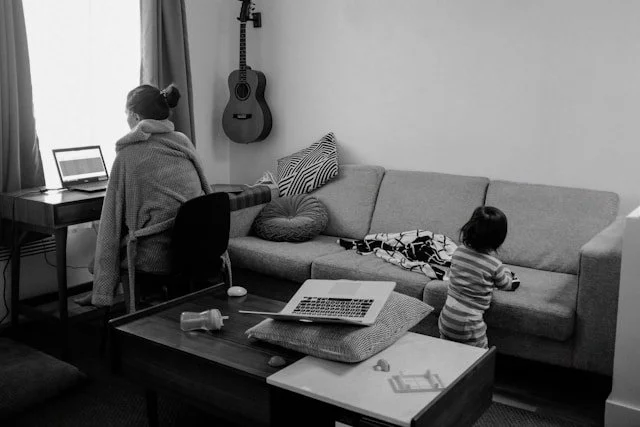
Photo by Charles Deluvio via Unsplash
Your Policies are Your Brand. Especially This One.
I often have to educate people that a brand is more than a logo. A brand is the sum of what an organization says, and what an organization actually does. A job description is a major brand artefact for prospective talent. Your employee handbook is a brand artefact for new employees. A corporate announcement is a broadcast of your brand values to your entire workforce, customers, and competitors.
A return-to-office mandate is one of the loudest brand signals a company can send, and most leaders issue it as if it were a memo about keeping the breakroom tidy. Think about what a blanket five-day mandate actually communicates. It says we value visibility over outcomes — that we'd rather see you than listen to you. It says we don't trust you to make an adult decision about where you do your best thinking. And, whether intended or not, it says this organization was built for the worker with no one to pick up at three o'clock, and we'd prefer to keep it that way.
That is a positioning statement. If your company saw it written down as such, would they approve it?
The opposite is also true, which is the part I find genuinely useful for the small and growing businesses I work with. You may not be able to outbid a giant on salary. You can almost always out-flex one. A thoughtful, deliberate flexibility policy — not a free-for-all, but real trust paired with real coordination — is one of the strongest brand assets a mid-sized company has, and it's nearly free. It tells the most talented caregivers in your industry, the ones the greedy-work model keeps shedding, that there is a place built with them in mind. In a tight market for the kind of people who have options, that message does more recruiting than any careers page.
The leaders dragging everyone back to the temple aren't protecting the culture. They're protecting the altar. And the rest of the market is taking notes.

Has any actual work ever resulted from this configuration of humans? Photo by Vitaly Gariev via Unsplash.
Who’s Laughing Now?
The movie 9 to 5 came out in 1980. The reforms the women install — flex time, job-sharing, the daycare — seem obvious to anyone who stops and thinks about it, but even today they’re considered radical. And, of course, the reforms get results immediately (this is a Hollywood movie.) Productivity goes up, morale goes up, and the only thing standing between the company and all of that was one man's need to be obeyed in person.
Perhaps this movie was written as farce; there are dream sequences about hunting Hart down like a deer and roasting him over a fire. But the economic proposals aren’t so funny. Forty-six years later we have the studies, the Brookings data, the Nobel, the natural experiment of a global pandemic — and they all say roughly what the screenwriters intuited: that a great deal of what we call "the way work is done" was never about the work. It’s about who gets to feel important and powerful while the work happens.
The genuinely radical act in that film isn't the kidnapping, it's the daycare. The punchline is a quiet insistence that a workplace could be designed around the people in it rather than around the person at the top. We ran that experiment for real over the last six years. The global economy was tested in major ways, but it turns out that the most fragile fault line runs through the self-esteem of the C-suite.
Nancy Martira is a brand strategist and communications consultant. She delivers human-centered strategies tailored to your specific business challenges and market position. You can hire Nancy for brand positioning and content strategy projects. Have something else in mind? Let's talk.
